Human Intelligence
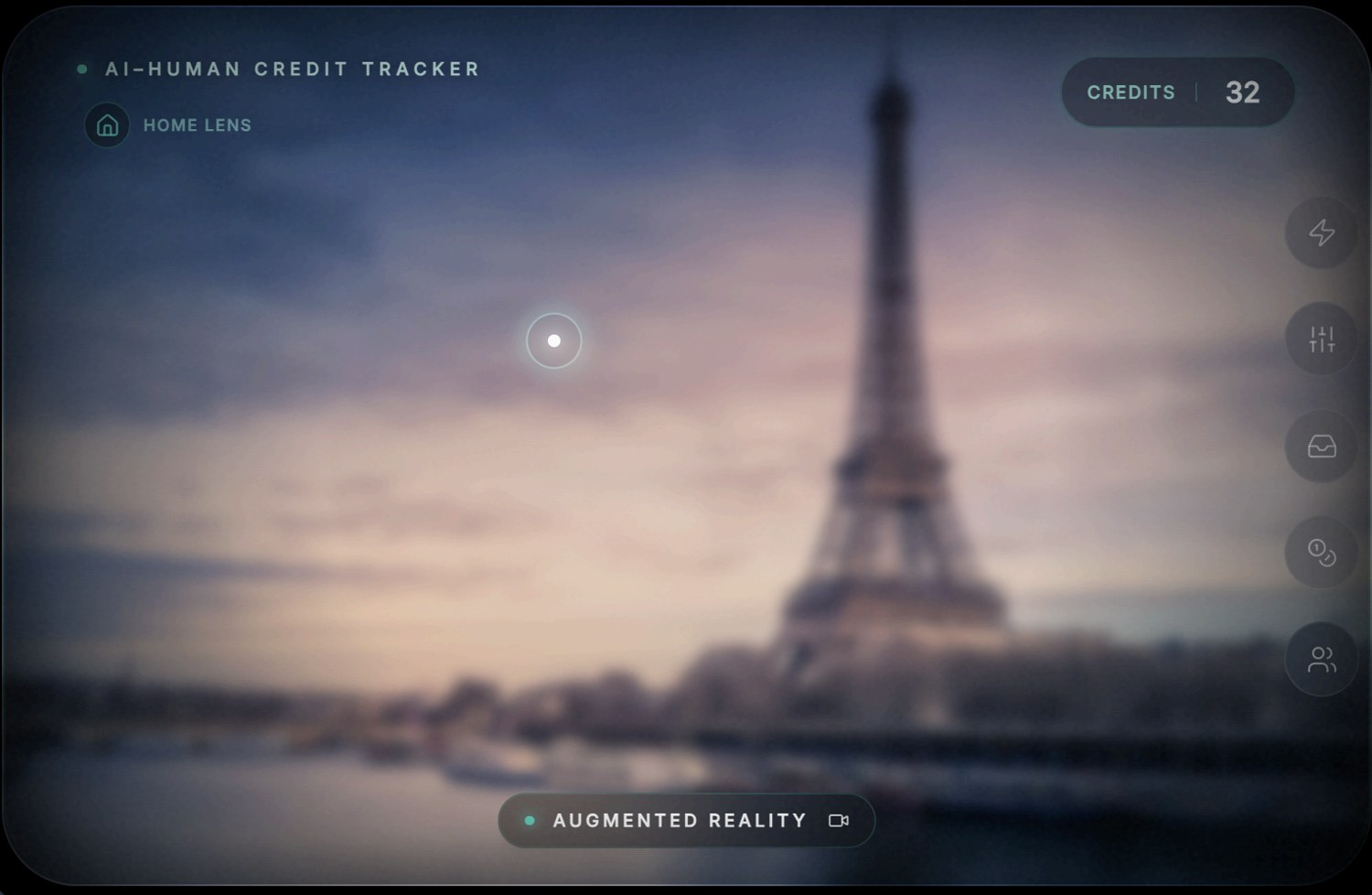
A speculative AR communication system designed to rebuild authentic human connection in an AI-saturated future.
Role
UX Designer
Team
Carley Kerby, Kate Fretz, Sanaa Khalil
Course
DEI 613
Timeline
4 weeks
Platform
AR Contact Lens Interface
Project Type
Academic Speculative Design
Focus Areas
Tools
Overview
Human Intelligence, also called HI, is a speculative design concept set in the year 2050. The project imagines a future where artificial intelligence mediates most social interactions, from work communication and scheduling to emotional support, family conversations, and friendship.
In this future, people are constantly connected through technology, yet increasingly disconnected from one another. As AI handles more communication, people begin to lose confidence in direct conversation, emotional expression, and authentic human connection.
Human Intelligence responds to this future by proposing a government-led AR contact lens system that helps people rebuild social skills, verify authentic human interaction, and gradually reduce overreliance on AI-mediated communication.
The Future Challenge
Societal Problem
By 2050, AI agents mediate most conversations, making human-to-human interaction feel unfamiliar, risky, and emotionally difficult.
Human Problem
People experience loneliness, reduced emotional intelligence, weakened social confidence, and uncertainty about whether communication is truly human or AI-generated.
Design Opportunity
Create a speculative system that does not remove AI entirely, but helps rebalance the relationship between AI support and authentic human communication.
How might we design a digital tool or experiential system that encourages people to rebuild social skills and emotional intelligence in 2050, after decades of reliance on AI-mediated communication have weakened human connection?
World Building
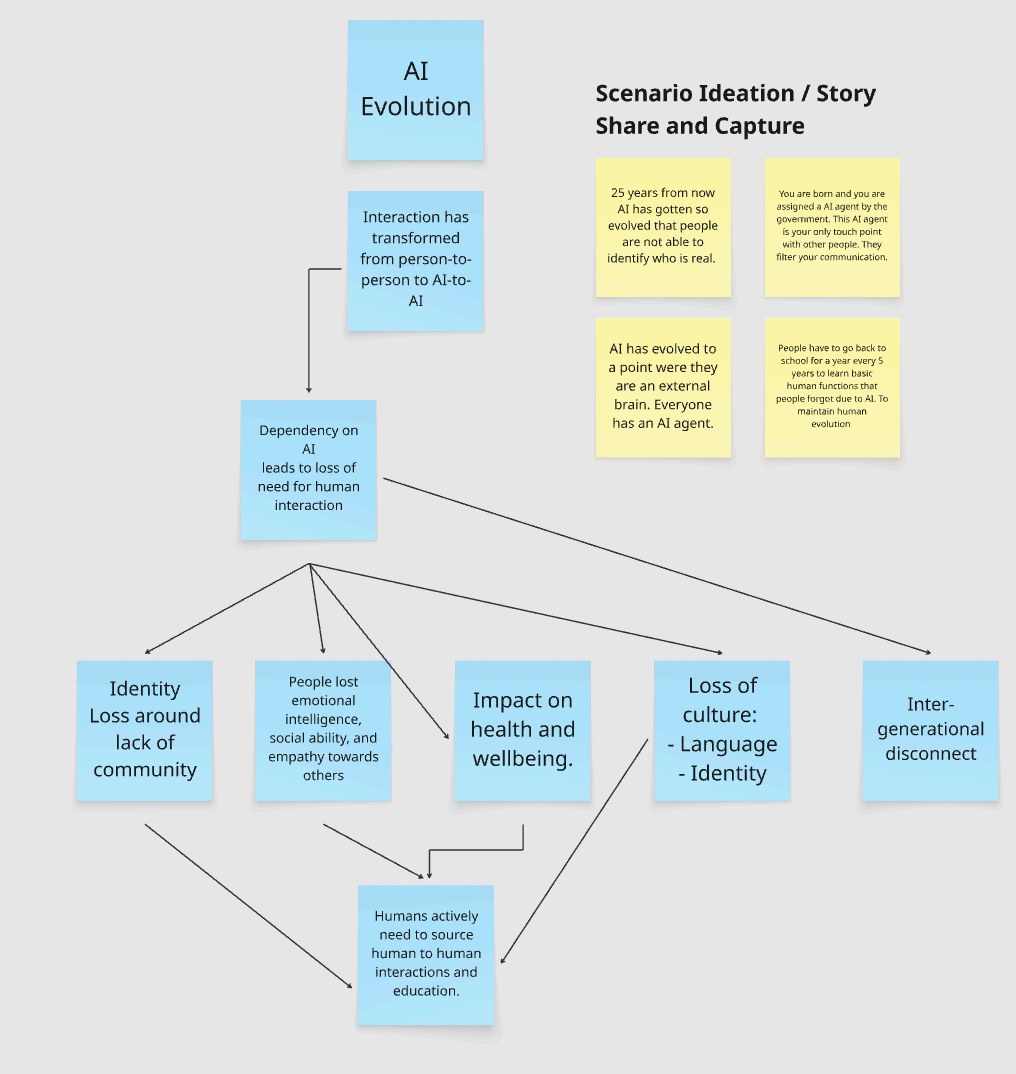
The emerging asocial society — our 2050 future scenario.
Our team developed a future scenario called the emerging asocial society. In this world, AI has become deeply embedded in everyday communication. People use personal AI agents to write messages, manage relationships, negotiate conflict, and interpret emotions.
This creates a society that is digitally efficient but emotionally distant. Human interaction becomes less common, emotional literacy declines, and people become unsure how to communicate without AI support.
AI-Mediated Communication
Personal AI agents manage conversations, emotional tone, scheduling, work negotiations, and social interactions.
Declining Social Skills
As AI smooths over conflict and emotion, people have fewer opportunities to practice empathy, vulnerability, and spontaneous communication.
Ambiguous Authenticity
AI-generated speech, avatars, and messages become so realistic that people struggle to know whether they are interacting with a human or an algorithm.
Regulated Digital Society
Governments become involved in regulating AI communication, emotional data, identity verification, and access to virtual spaces.
Target Users
Three AI-enhanced personas across generations and cultures.
Lian Torres
19 · Manila
A university student who has grown up entirely in AI-mediated environments. Her AI shapes her tone, manages her schedule, and handles social interactions. Although she is constantly connected online, she feels anxious during unscripted communication and worries she does not know how authentic emotion works outside algorithms.
Needs
- Safe opportunities to practice unfiltered conversation
- Support for social anxiety without full AI replacement
- Tools that help her understand emotions beyond AI labels
Amadou Toure
47 · Paris
A community liaison caught between pre-AI social norms and a world where communication is optimized by autonomous agents. His AI handles most negotiation tasks, making him feel overshadowed at work and misunderstood at home. He wants to reconnect with his children in a more genuine, human way.
Needs
- Tools that bridge generational communication expectations
- Support for difficult conversations without overwriting his personality
- A way to communicate without feeling surveilled or over-mediated
Elena Marković
72 · Zagreb
A retired archivist living alone with a government AI caregiver. Her children often communicate through algorithms instead of using their real voices, leaving her emotionally isolated despite constant digital contact. She longs for communication that feels real, grounded, and human.
Needs
- Human-centred communication options that are easy to access
- Verification that messages and conversations are truly human-authored
- Community structures that prioritize presence over automation
Research & Design Foundations
The project was grounded in speculative design, future casting, AI-enhanced personas, prompt engineering, and design thinking. Our personas were developed through a structured prompt-engineering process that helped us explore how different generations might experience AI-saturated communication in 2050.
We used iterative prompting to develop emotional context, pain points, cultural tensions, AI reliance, and unmet needs. This helped us move beyond surface-level future scenarios and create personas that felt human, specific, and believable.
Speculative Design
Exploring possible futures to question how current technologies could shape human behaviour, society, and ethics.
Future Casting
Imagining a grounded 2050 scenario based on current trends in AI reliance, loneliness, remote work, and mediated communication.
AI-Enhanced Personas
Using prompt engineering to create detailed future personas with emotional depth, social context, and generational differences.
Design Thinking
Using empathize, define, ideate, prototype, and test stages to move from future scenario to design solution.
What I Did
My role as the UX Designer on the team.
As the UX Designer on the team, I focused on translating the future scenario into user-centred design opportunities and early interaction flows.
Design Process
Five stages from future scenario to AR concept.
Empathize
We began by future-casting life in an asocial society in 2050. Through infinity mapping and scenario mapping, we explored how AI-mediated communication could affect loneliness, emotional intelligence, trust, and human interaction.
Define
We developed three personas across different generations and cultural contexts to understand how AI dependence might affect users differently. This helped us define the core problem: people in 2050 have become over-reliant on AI, weakening human-to-human communication.
Ideate
We used collaborative ideation in Miro to explore possible interventions. Each team member contributed ideas and voted on the strongest direction. This led to the concept of Human Intelligence: a system that incentivizes real human connection while still allowing supportive AI guidance.
Prototype
We created low-fidelity wireframes, a user flow, and a medium-fidelity prototype to visualize how an AR contact-lens interface might work in a real-world environment. The interface needed to support human interaction without overwhelming the user’s field of view.
Test & Refine
After group critique, we refined the concept and shifted from Figma Make to Google AI Studio to improve the functionality and user experience of the final prototype.
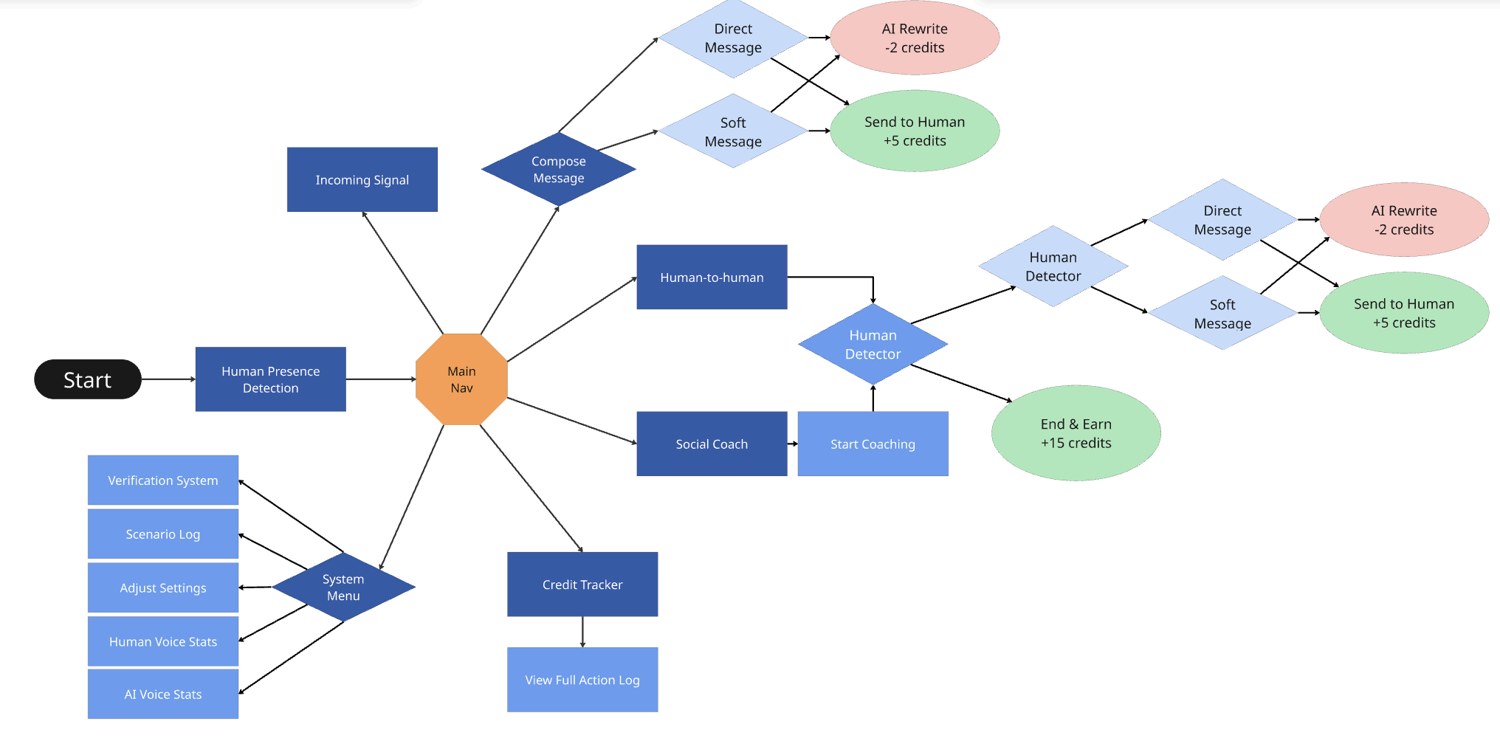
Concept Overview
Human Intelligence is a government-led AR lens system designed for a future where most communication is handled by AI agents.
Instead of replacing the human voice, HI tracks authentic human interaction and rewards users for practicing real communication. When someone chooses to speak for themselves, they earn Human Credits that unlock supportive AI tools.
The goal is not to eliminate AI, but to help people rebuild confidence, emotional intelligence, and trust in their own voice.
Be human. Learn with guidance. Reconnect with confidence.
Why an AR Contact Lens?
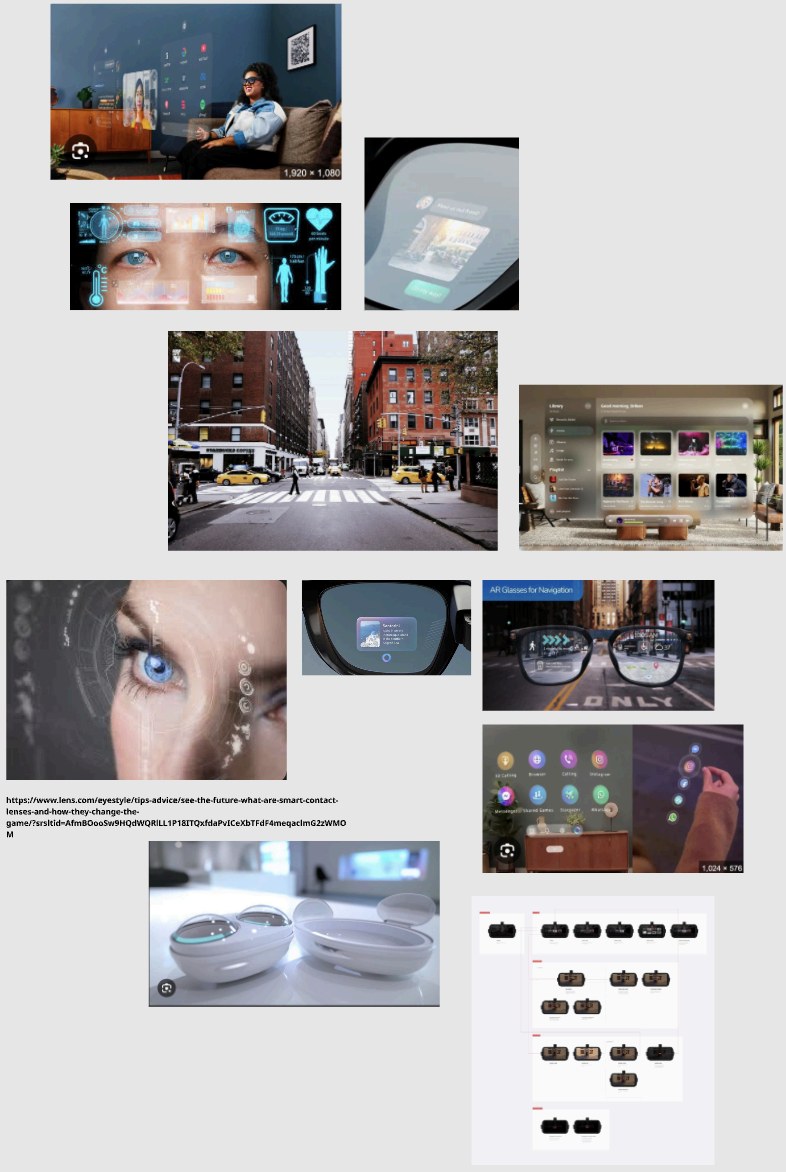
In our 2050 scenario, AR lenses have replaced traditional screens and become the primary interface for identity, communication, and AI assistance.
An AR contact lens allows HI to support users hands-free and in real time without pulling their attention away from the person in front of them. It can also detect real-world cues such as heat, voice, movement, emotion, and human presence, making it more effective than a phone-based system for verifying authentic human interaction.
Hands-Free Support
Users receive subtle guidance without breaking eye contact or leaving the conversation.
Real-Time Social Context
The system can detect tone, presence, emotional risk, and conversation patterns during interaction.
Human Verification
The lens can confirm when users are speaking to a real human rather than an AI agent or synthetic avatar.
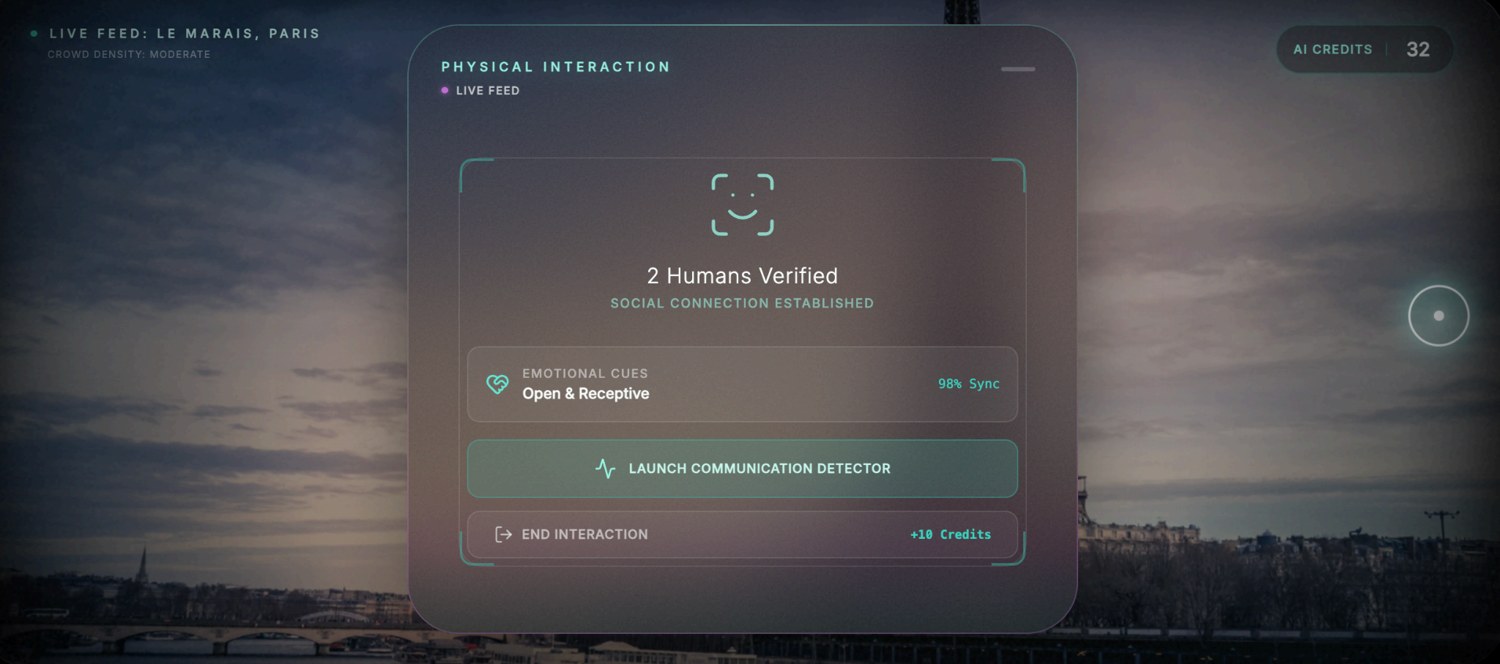
Key Features
Five system features, each anchored to a persona.
Authenticity Detection
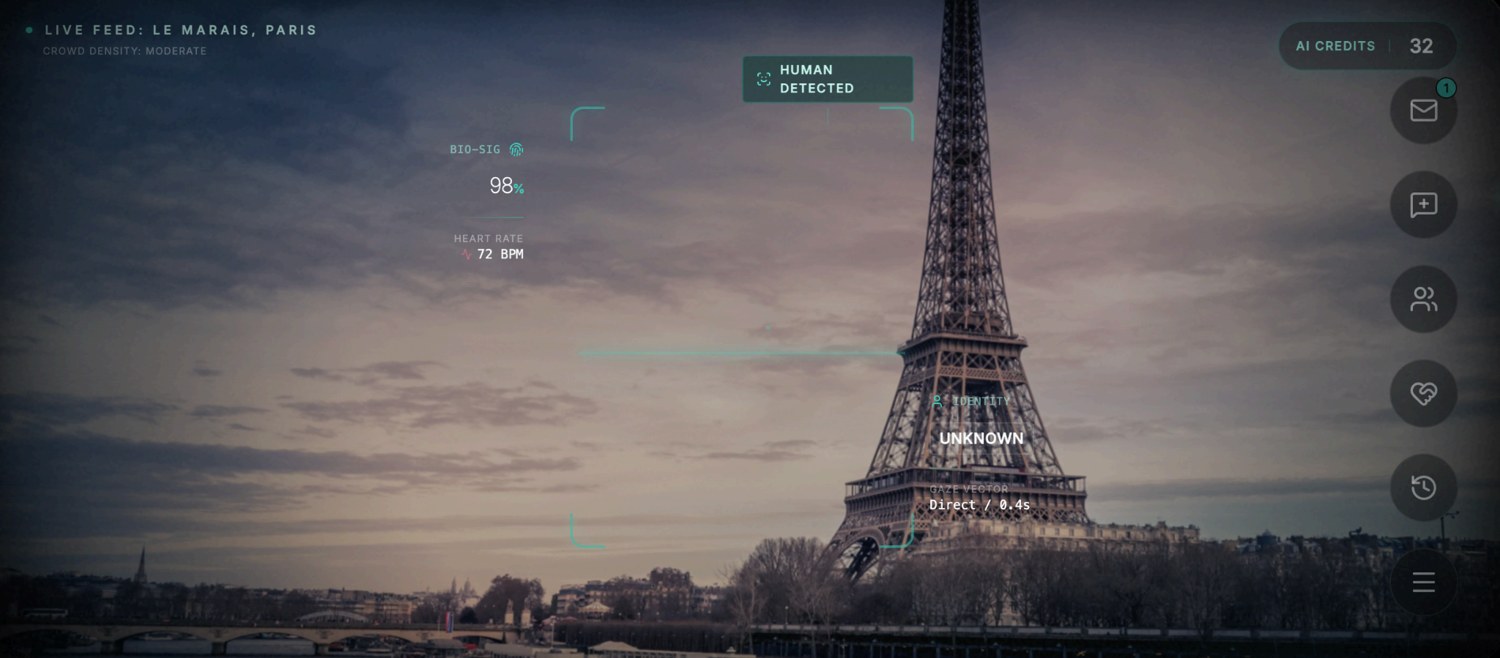
The authenticity detector confirms whether a user is interacting with a real human rather than an AI agent, synthetic voice, or AI-generated avatar. This helps rebuild trust in a world where people can no longer easily identify what is human.
Best supports: Elena, who needs reassurance that her interactions are genuine and not AI-generated.
Human / AI Mediation Slider
The mediation slider lets users choose how much AI support shapes their communication. Users can move between “Mostly Me,” light AI polish, balanced mediation, or stronger AI assistance depending on the situation.
Best supports: Lian, who needs a bridge between full AI dependence and fully unscripted communication.
Human Credits
Human Credits are earned through verified human-to-human interaction. Users can spend credits on supportive AI tools, creating a system where AI support is tied to practicing real social behaviour.
Best supports: All personas, because it rewards emotional effort, not performance.
Social Coaching
Social coaching provides gentle real-time support during tense or difficult moments. It helps users regulate emotions, prepare for conversations, and practice healthier communication without replacing their voice.
Best supports: Amadou, who wants support in emotional situations without losing authenticity.
Scenario Log
The scenario log tracks human contact, AI reliance, communication choices, and emotional growth over time. It helps users reflect on patterns and become more aware of how much they rely on AI.
Best supports: All personas, because it helps users understand their social progress and dependence on AI over time.
Core Experience Walkthrough
Eight moments from the HI prototype.
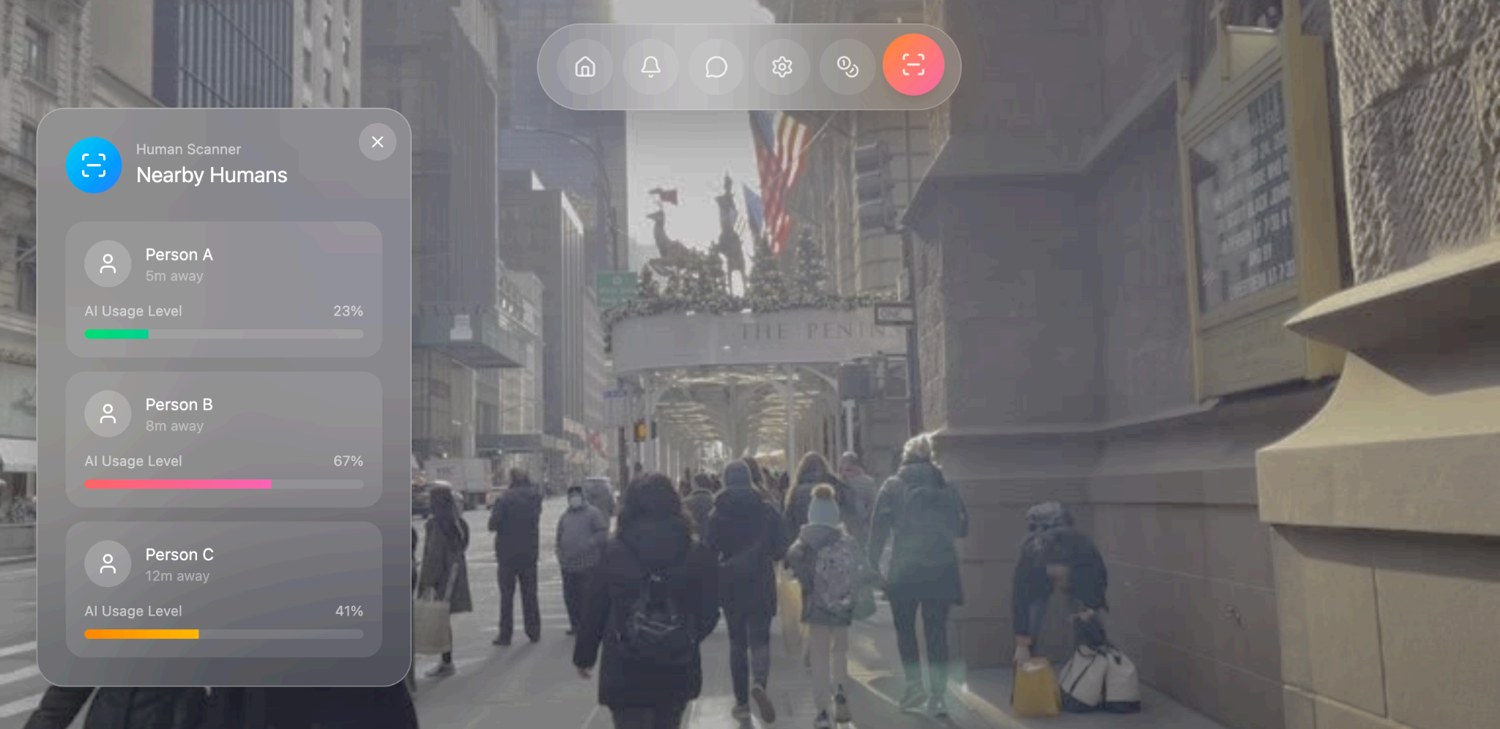
Detecting a Human
The AR lens identifies a nearby person, confirms they are human, and displays subtle biometric or authenticity cues.
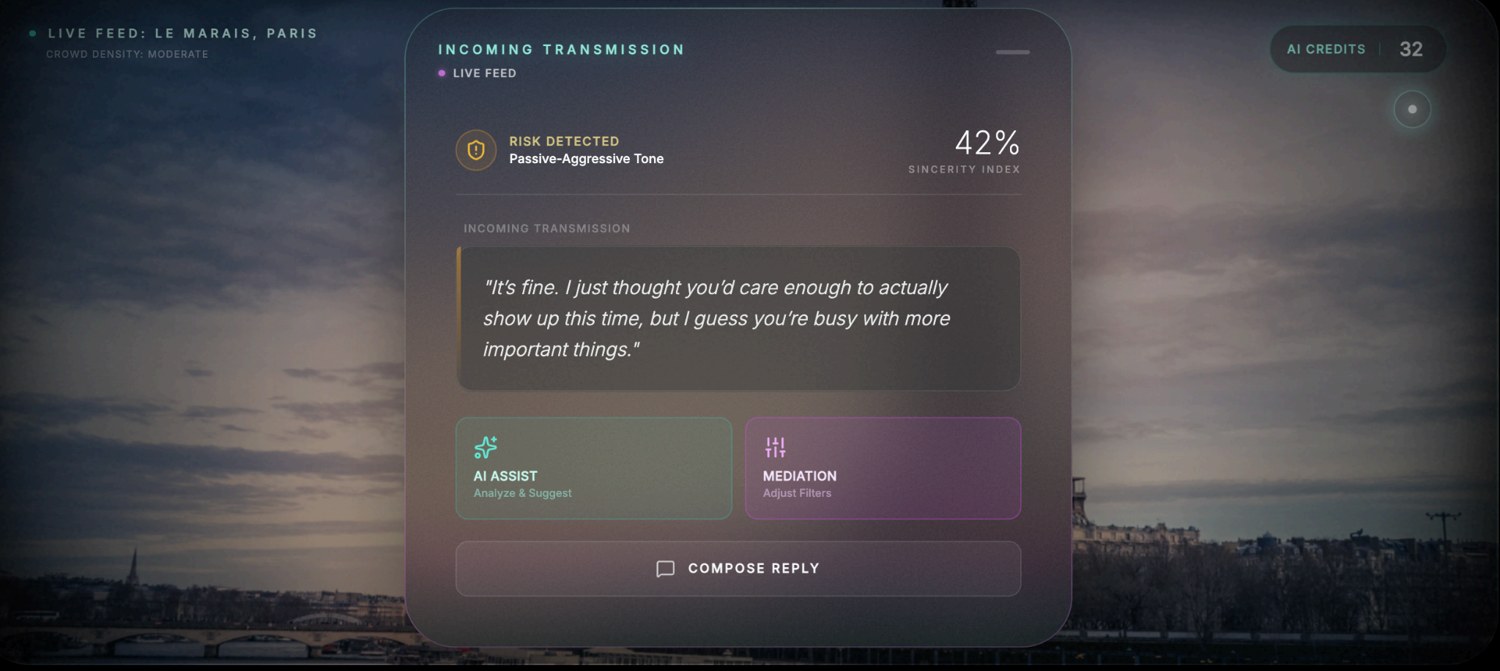
Incoming Message + Tone Risk
The user receives a message with a passive-aggressive or emotionally complex tone. HI highlights tone risk and provides a sincerity index.
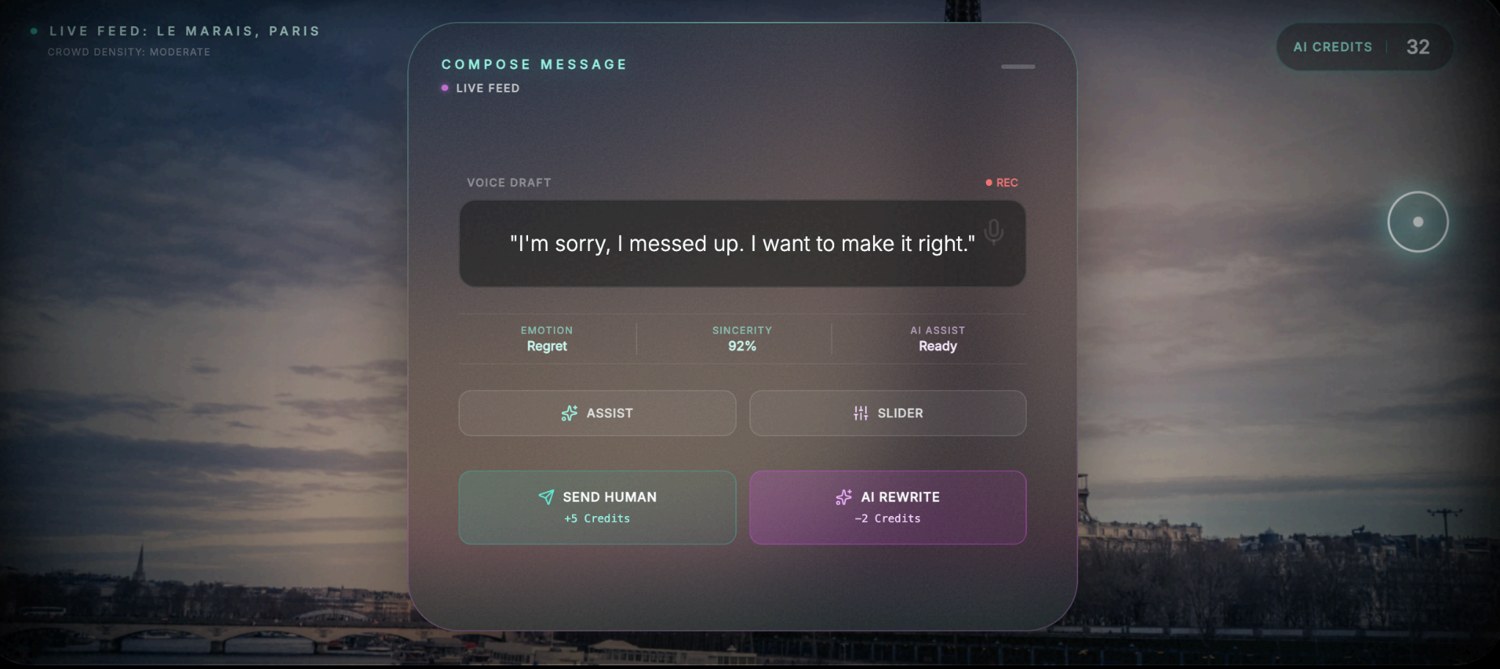
Choosing AI Assist or Mediation
The user chooses whether to respond independently, use AI suggestions, or adjust the mediation slider.
Tone Mediation Slider
The user decides how much AI support they want, balancing clarity with authenticity.
AI Suggestions
HI offers a few phrasing options, but the user can edit them before sending so the response still feels personal.
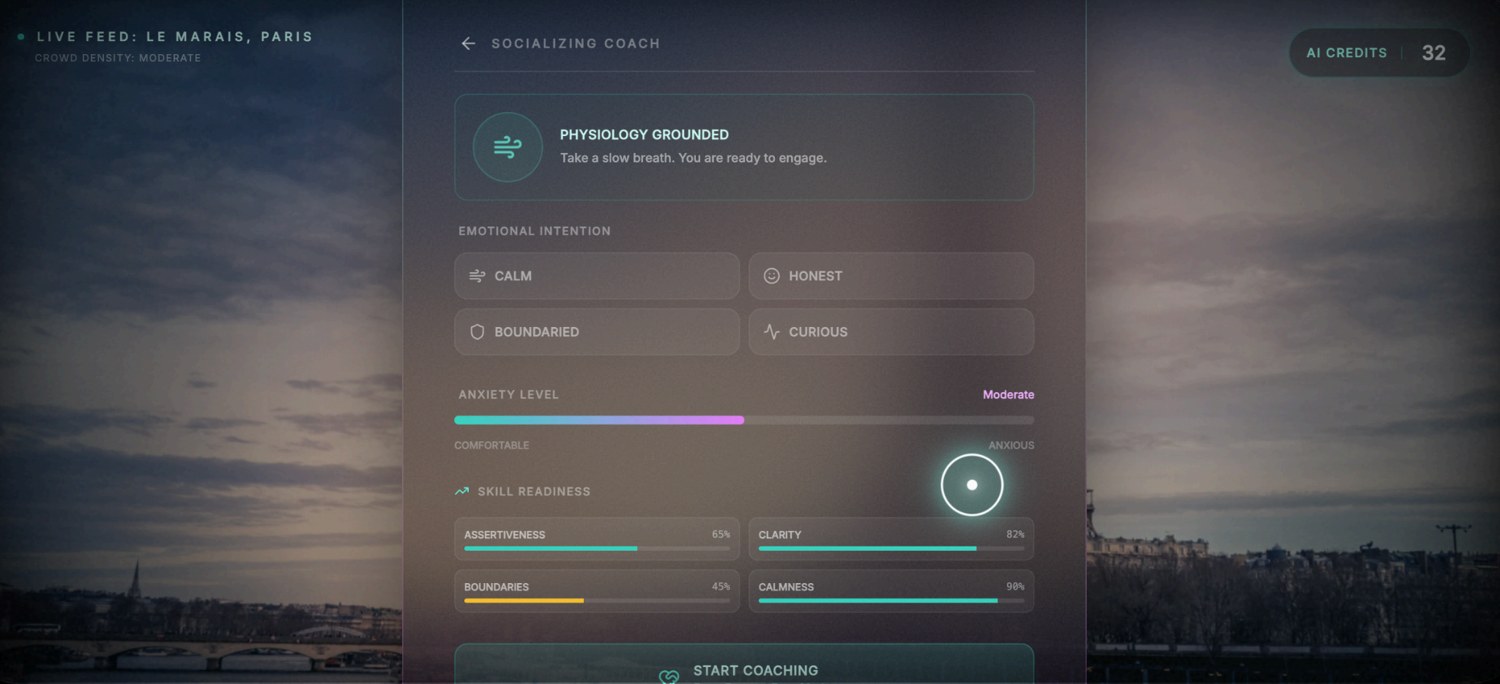
Social Coaching Mode
Before a difficult conversation, HI helps the user regulate breathing, set an intention, and enter the interaction calmly.
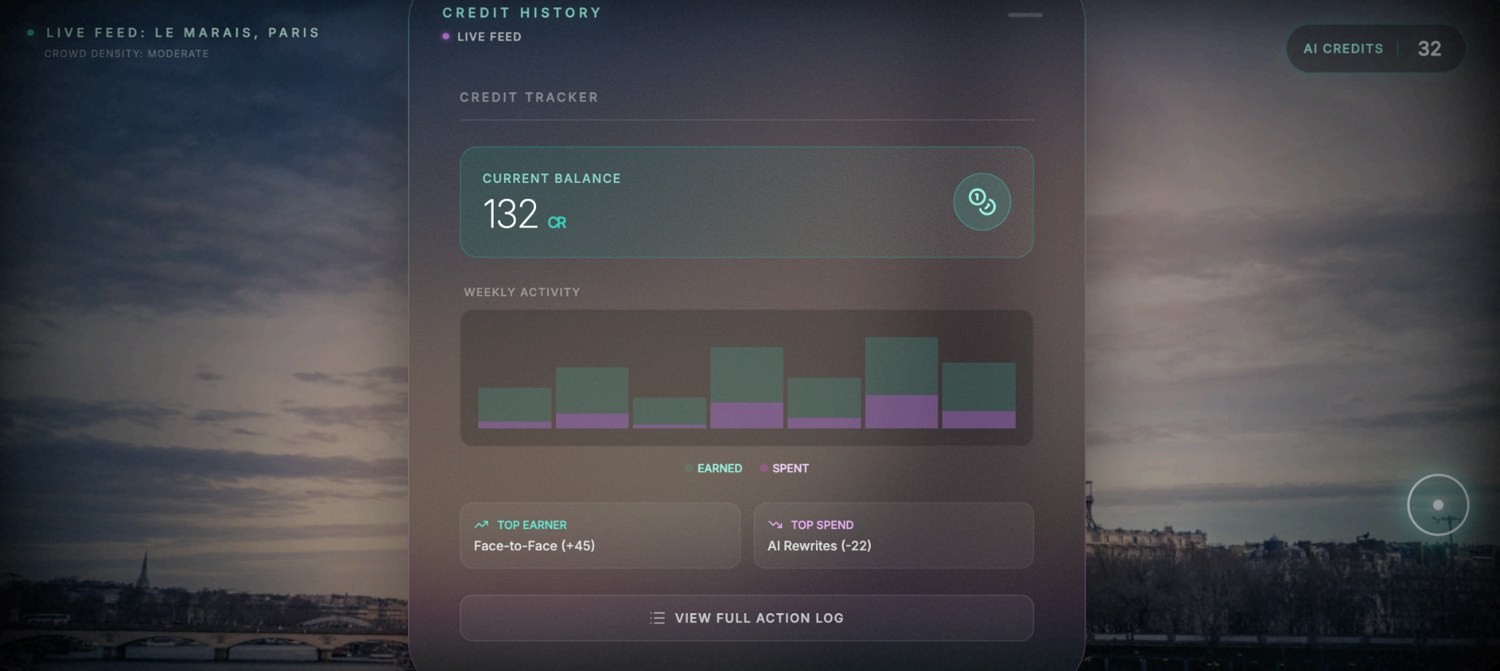
Credit Tracker
Users earn Human Credits through real interaction and spend them on AI support when needed.
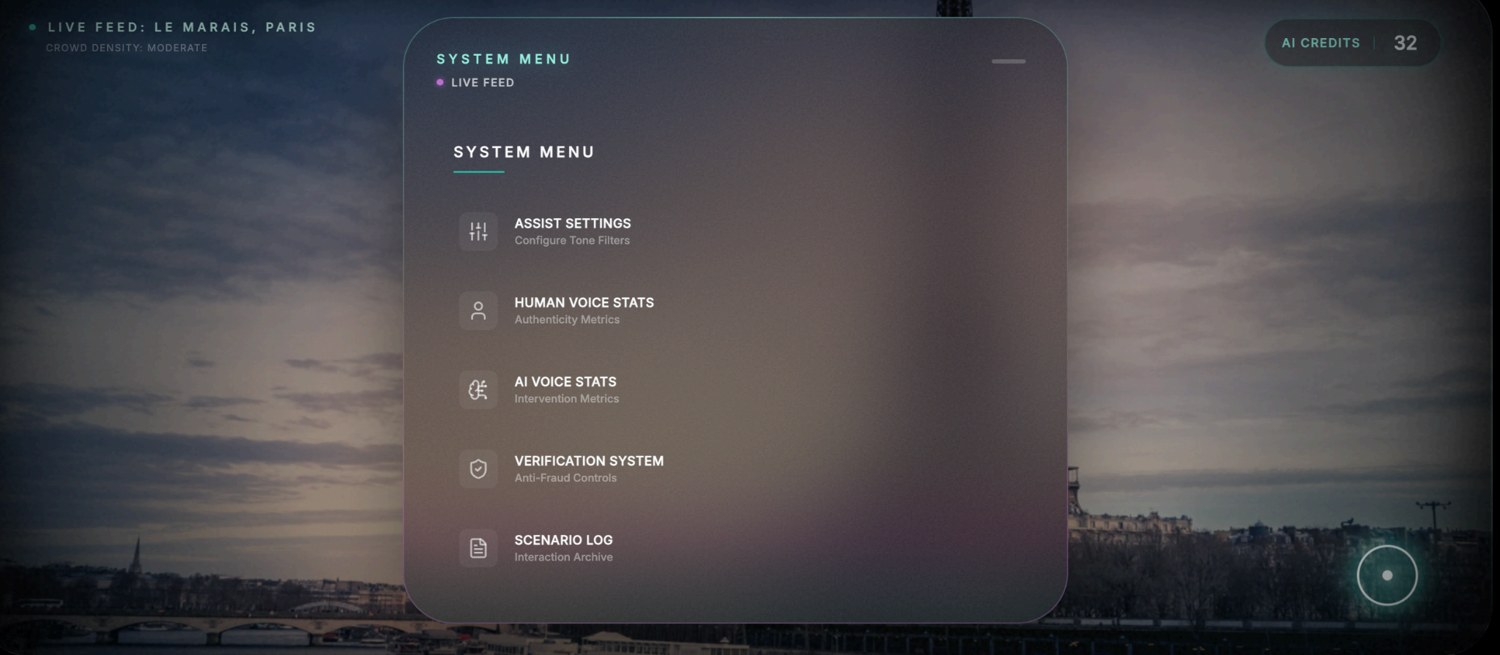
System Menu
Users can review voice patterns, AI reliance, social confidence, and long-term communication growth.
Visual Design Direction
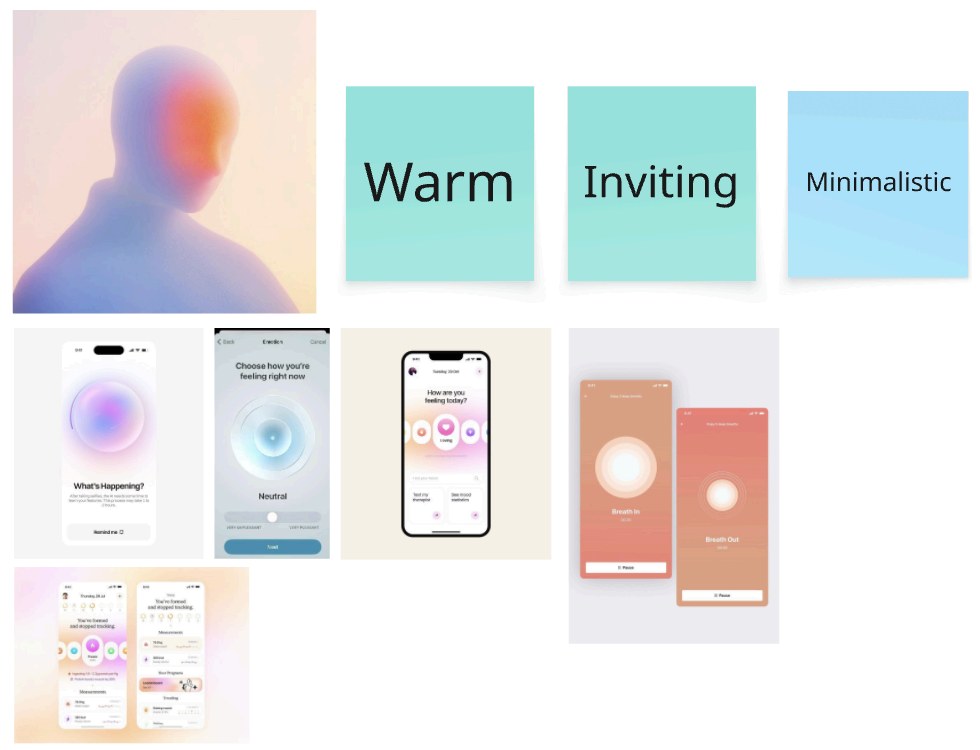
The visual direction for Human Intelligence was intentionally minimal, warm, and ambient. Because the system exists inside an AR contact lens, the interface needed to feel supportive without overpowering the user’s real-world environment.
Prototype Evolution
From hand sketches to high-fidelity AR flows.
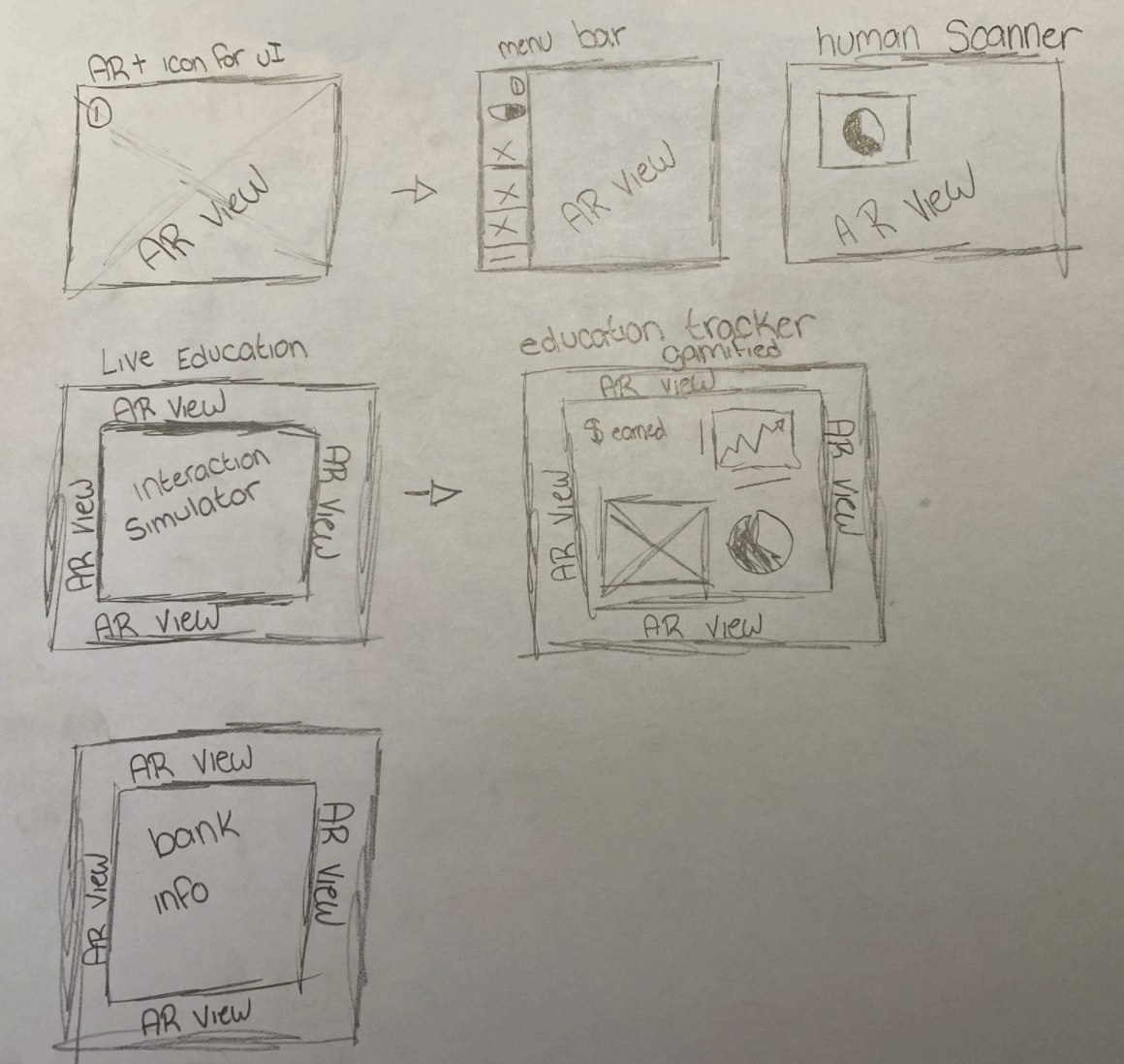
Early Sketches
We began with low-fidelity sketches to explore how an AR overlay could support communication in a physical environment.
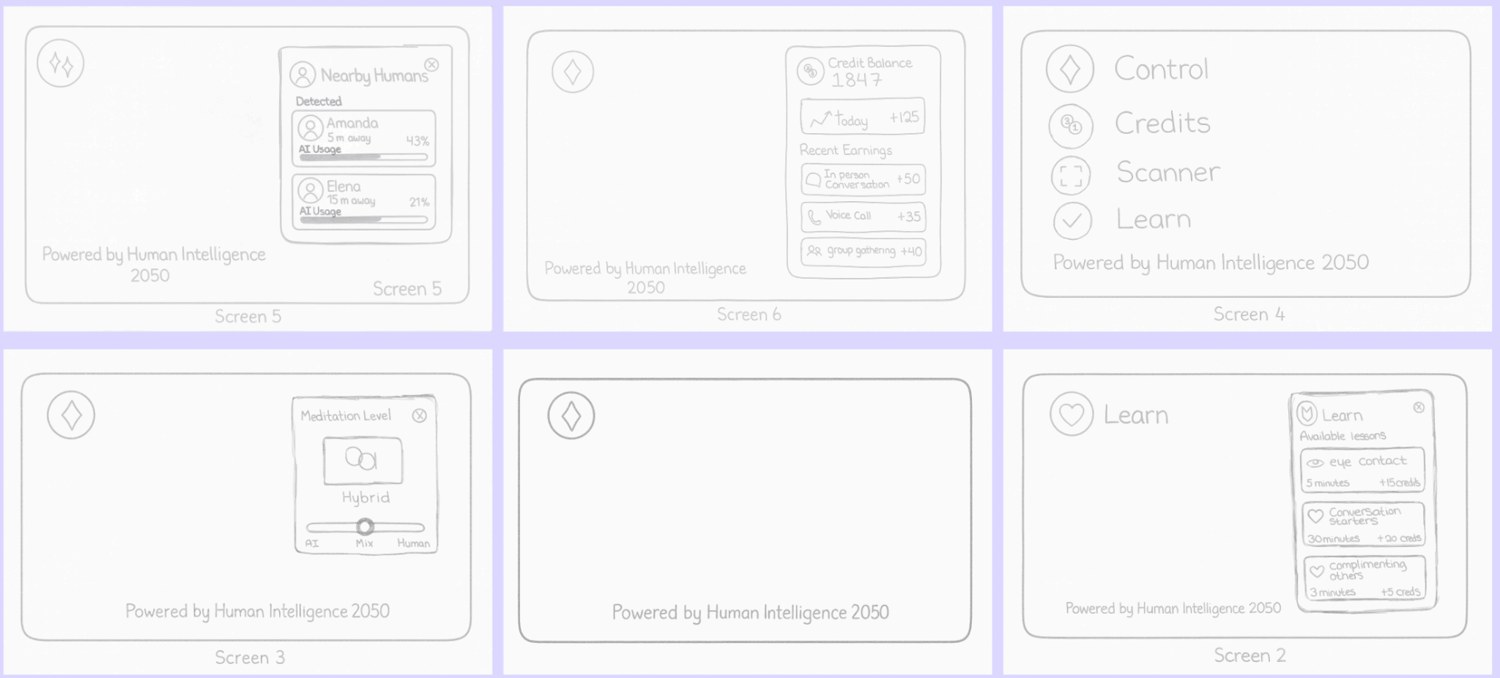
Medium-Fidelity Prototype
The medium-fidelity prototype explored widget placement, menu structure, notifications, mediation levels, credit balance, and human scanning.
Post-Critique Refinement
After feedback, we refined the interface to better support functionality, emotional clarity, and user experience.
Final Prototype
The final prototype included high-fidelity flows for the home screen, incoming messages, composing a message, human validation, social coaching, credit tracking, and system settings.
Design Decisions
Support human communication, do not replace it
HI does not remove AI. Instead, it gives users scaffolding so they can gradually rebuild confidence in their own voice.
Reward emotional effort
The credit system rewards verified human contact and social effort rather than performance, popularity, or productivity.
Make AI support adjustable
The mediation slider recognizes that users have different comfort levels and should be able to choose how much support they need.
Prioritize trust and authenticity
The authenticity detector responds to a future where people struggle to know whether communication is real, human-authored, or AI-generated.
Keep AR interaction subtle
The interface is designed to guide users without overwhelming the conversation or replacing real-world presence.
Ethical Considerations
Because Human Intelligence deals with emotional data, communication, government regulation, and human behaviour, ethical concerns were central to the concept.
These questions helped us position Human Intelligence as a speculative provocation, not a perfect solution. The goal of the project is to question how AI should support human connection without replacing the emotional labour that makes relationships meaningful.
Impact
Framed as future design value — this is a speculative concept, not a launched product.
Rebuilds Social Confidence
HI helps users practice direct communication in a future where human interaction has become unfamiliar.
Reduces Loneliness
By incentivizing real human contact, the system aims to reconnect people who have become isolated by AI-mediated life.
Rebalances Human-AI Relationships
The concept challenges the idea that AI should optimize all communication and instead asks how AI can support human growth.
Limitations
Because Human Intelligence is a speculative design concept, there are important limitations and unanswered questions.
Future Improvements
User Testing
Test the concept with participants across different age groups to understand how people respond to AI mediation and authenticity detection.
Ethics Framework
Develop clearer rules for privacy, consent, emotional data, and government involvement.
Accessibility Testing
Explore how the AR lens would support users with visual, cognitive, emotional, or social accessibility needs.
Expanded Scenario Design
Build more future scenarios beyond 2050 to test how HI might work across different cultures, communities, and political systems.
Prototype Refinement
Create a more interactive prototype that demonstrates real-time tone mediation, credit tracking, and social coaching flows.
Reflection
Human Intelligence challenged me to think beyond traditional app design and consider how technology shapes behaviour, relationships, and society.
This project helped me understand the value of speculative design as a way to question the future before it happens. Instead of designing only for convenience or efficiency, our team had to ask what might be lost when communication becomes too automated.
My biggest takeaway was that AI should not replace human connection. If designed responsibly, AI can act as a scaffold that helps people rebuild confidence, emotional intelligence, and trust. However, speculative concepts like HI also reveal the risks of measuring, regulating, or gamifying human behaviour too aggressively.
If I continued this project, I would focus more deeply on ethical safeguards, privacy protections, accessibility, and user testing across generations.
Skills Demonstrated
Human Intelligence reflects my interest in designing emerging technologies that do not just optimize behaviour, but protect what makes us human: empathy, trust, emotion, and connection.