Fit4All
Designing an inclusive, gamified fitness experience for people with mobility impairments.
Role
Lead UX / Gamification Designer
Timeline
4 weeks
Platform
Mobile iOS
Project Type
Academic Concept Project
Course
DD441 / EM441 Gamification & Game-Based Learning
Focus Areas
Accessibility · Inclusive Design · Gamification
Tools
Overview
Fit4All is an inclusive, gamified fitness mobile app concept designed for people with mobility impairments, people recovering from physical injuries, and older adults with reduced mobility.
Many mainstream fitness apps are built around able-bodied movement, high-intensity goals, competitive metrics, and generic workout routines. These experiences can make users with mobility limitations feel excluded, unsafe, or unsupported.
Fit4All reimagines fitness motivation through adaptive workouts, accessibility-first personalization, personal trainer support, progress tracking, achievements, and gamified systems that reward consistency and participation rather than physical intensity.
The Design Challenge
User Problem
People with mobility impairments often struggle to find safe, adaptive, and motivating fitness experiences that reflect their abilities and needs.
Product Problem
Most fitness apps prioritize able-bodied movement, speed, intensity, and competition, leaving many users feeling discouraged or excluded.
Design Opportunity
Create a fitness app that uses inclusive design and meaningful gamification to support motivation, accessibility, confidence, and long-term healthy habits.
How might we redesign the fitness experience for users with mobility impairments through inclusive design and health-focused gamification?
Target Users
Three personas anchored the design in real, diverse needs.
Mobility Impaired User
- Context
- Wheelchair user or user with limited mobility
- Need
- Adaptive seated workouts, accessible navigation, and flexible goal setting
- Pain Point
- Mainstream apps often assume standing movement or full-body mobility
- Accessibility Need
- Preset accessibility modes, hands-free controls, and personalized workout recommendations
Recovering from Injury
- Context
- Recovering from a knee injury, spinal injury, surgery, or physical setback
- Need
- Safe progression and adaptive workout intensity
- Pain Point
- Fear of re-injury from generic workout plans
- Accessibility Need
- AI-adjusted workouts, trainer guidance, and safety-conscious recommendations
Older Adult
- Context
- Reduced mobility, exercises at home
- Need
- Simple, low-impact guidance and clear instructions
- Pain Point
- Overwhelming interfaces, small text, and inaccessible workout expectations
- Accessibility Need
- Large UI elements, voice guidance, saved preferences, and low-impact routines
Design Goals
Make fitness feel accessible
Design workouts around different bodies, abilities, and comfort levels.
Support motivation without shame
Use gamification to encourage consistency without punishing users for missed days or physical limitations.
Personalize the experience
Allow users to set goals, choose activity types, adjust intensity, and save accessibility preferences.
Build confidence over time
Help users track progress, celebrate achievements, and develop long-term habits at their own pace.
Research & Design Foundations
Fit4All was grounded in gamification theory, inclusive design principles, Self-Determination Theory, Bartle’s Player Types, and Nicholson’s RECIPE framework for meaningful gamification.
Rather than using gamification only as points, badges, and leaderboards, the design focuses on motivation that feels personal, supportive, and emotionally safe.
Self-Determination Theory
Fit4All supports autonomy, competence, and relatedness by giving users choice, achievable progress, and supportive social features.
Meaningful Gamification
The app uses gamification to encourage reflection, personal growth, choice, play, and engagement rather than relying only on external rewards.
Bartle's Player Types
The system considers different motivations: achievers, explorers, socializers, and competitive users.
Inclusive Design
Accessibility is built into the core experience rather than added as an afterthought.
Core Experience Walkthrough
Four key screens from the Fit4All prototype.
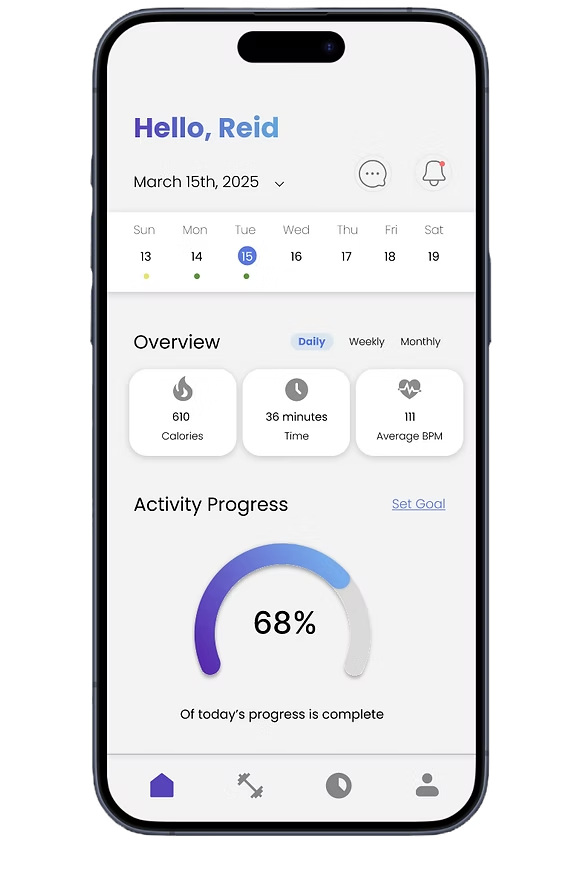
Home Dashboard
The dashboard gives users a quick overview of their daily activity — calories, workout time, average BPM, calendar progress, and an activity progress ring. The goal is to make progress feel visible, simple, and motivating.
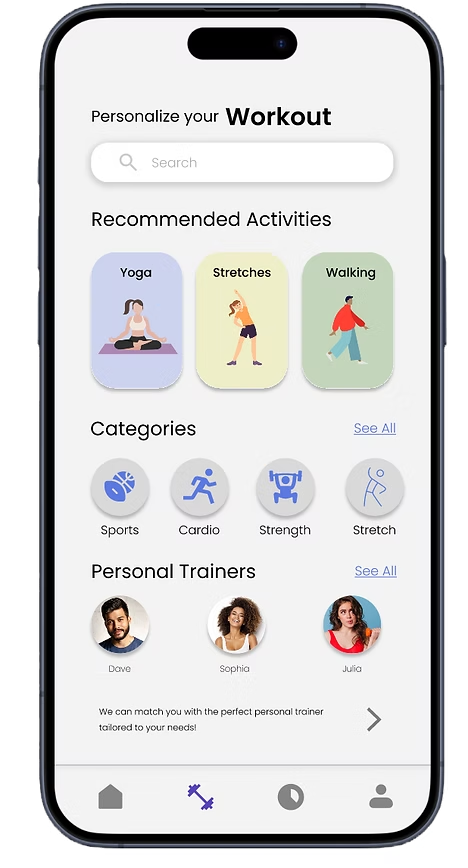
Personalized Workout Page
Users can search for workouts, browse recommended activities, explore categories such as sports, cardio, strength, and stretching, and connect with personal trainers. The experience supports different ability levels and encourages users to choose what feels safe and achievable.
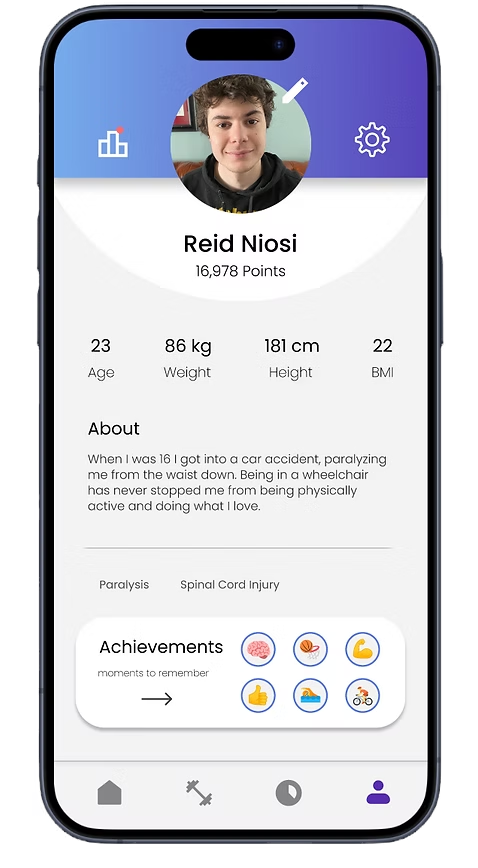
Profile & Achievements
The profile page displays user stats, personal information, points, accessibility-related details, and achievement badges. This helps users reflect on progress and feel recognized for consistency and participation.
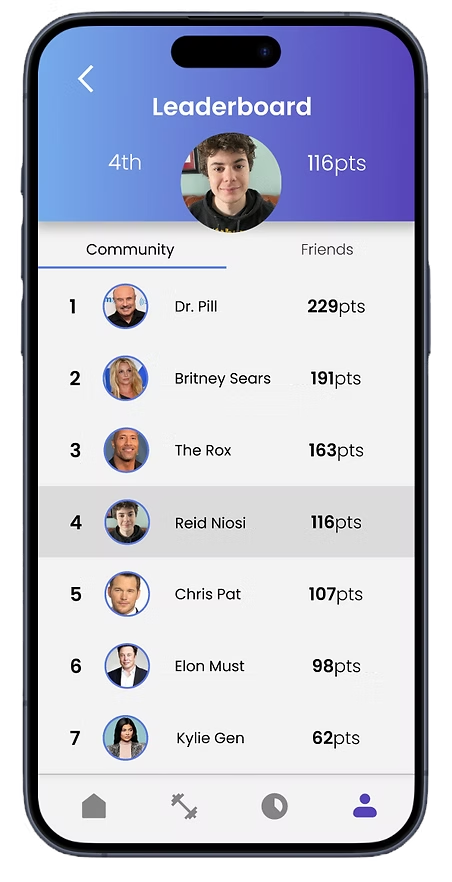
Leaderboard
The leaderboard creates a social layer for motivation. Instead of focusing only on athletic performance, Fit4All rewards participation and engagement. The community and friends tabs help users feel connected while keeping competition optional and supportive.
Gamification System
Mechanics designed to reward effort, exploration, and consistency.
Points
Users earn points for completing workout sessions, engaging with personal trainers, browsing routines, logging in, maintaining streaks, reaching weekly or monthly goals, unlocking achievements, and sharing the app with friends. Points reward consistency, exploration, and participation.
Levels
Fit4All uses activity-specific levels rather than one universal level. A user can progress separately in yoga, cardio, strength, stretching, or aqua aerobics — growing at a safe pace within each activity and preventing the app from pushing users too quickly.
Achievements
Badges celebrate different types of progress — first workouts, workout streaks, trying new categories, connecting with friends, engaging with trainers, attending events, and reaching activity milestones.
Leaderboard
Designed to support friendly motivation rather than shame-based comparison. Ranking is based on participation and app engagement rather than physical performance, speed, or intensity.
Personalized Journey Tracker
The journey tracker helps users reflect on daily, weekly, and monthly progress through visual progress bars, calendars, graphs, and goal tracking — supporting long-term motivation by helping users see how far they have come.
Accessibility Features
Inclusion built into the core experience, not bolted on.
Adaptive Workout Recommendations
Workouts adjust based on ability level, injury status, mobility needs, and user preferences.
Accessibility Presets
Preset modes for seated workouts, low-impact movement, voice guidance, larger text, or simplified navigation.
Personal Trainer Support
Connect with trainers for guidance, accountability, and safer workout planning.
Clear Visual Hierarchy
Large cards, simple navigation, recognizable icons, and readable spacing.
Optional Social Features
Users choose whether to engage with leaderboards, friends, trainers, or community features.
Safety-Conscious Progression
Levels increase gradually to reduce pressure and help prevent overexertion or injury.
Design Decisions
Reward participation, not intensity
Instead of rewarding only speed, calories, or high-performance goals, Fit4All rewards completion, consistency, exploration, and personal progress.
Separate levels by activity
Users progress independently within each workout category so they can safely build confidence without being pushed into movements that do not match their abilities.
Make competition optional
The leaderboard exists for users who enjoy social motivation, but the experience also supports users who prefer private progress tracking.
Use achievements for different motivations
Badges are designed for achievers, explorers, socializers, and competitive users so the app can appeal to different personality types.
Build accessibility into the core flow
Accessibility is not hidden in settings. It shapes onboarding, workout recommendations, goal setting, trainer support, and progress tracking.
Final Design Highlights
Impact
Framed as design value — this is a concept project, not a launched product.
Inclusive Fitness Experience
Fit4All challenges the assumption that fitness apps should be designed only around able-bodied movement.
Motivation Without Shame
The gamification system encourages consistency while avoiding punitive mechanics that could discourage users.
Scalable Product Concept
The framework could be expanded into wellness apps, rehabilitation tools, adaptive fitness platforms, or healthcare-supported mobility programs.
Limitations
Because Fit4All was created as an academic concept project, there are important limitations that would need to be addressed before development.
Future Improvements
Usability Testing
Test the prototype with mobility-impaired users, older adults, and people recovering from injuries.
Trainer Integration
Partner with adaptive fitness trainers or physiotherapists to create safer workout recommendations.
Expanded Accessibility Modes
Add voice control, screen reader optimization, larger text modes, haptic feedback, and simplified navigation.
AI Personalization
Explore an assistive AI feature, like FitBuddy, that could help users adjust workouts, set goals, and receive safe recommendations.
Long-Term Motivation Tracking
Study whether Fit4All's gamified system helps users maintain fitness habits over weeks or months.
Reflection
Fit4All taught me that inclusive design is not about adding accessibility at the end of a product. It requires rethinking motivation, progress, competition, and success from the beginning.
This project helped me understand how gamification can be used responsibly. Points, badges, and leaderboards can motivate users, but they can also discourage people if they are designed around shame, comparison, or unrealistic expectations.
The strongest part of Fit4All is its focus on making fitness feel personal, adaptive, and emotionally safe. If I continued this project, I would prioritize usability testing with disabled users, expert feedback from adaptive fitness professionals, and a more detailed onboarding system for accessibility needs.
Skills Demonstrated
Fit4All reflects my interest in designing digital experiences that are not only functional, but empowering, inclusive, and motivating for real people with diverse needs.