Gamification & Flow State
A mixed-methods UX research study exploring how game mechanics influence engagement, motivation, and flow within digital learning experiences.
Role
Independent UX Researcher
Institution
Wilfrid Laurier University
Supervisor
Dr. Maurita Harris
Timeline
8 months
Team
Solo, faculty supervised
Deliverables
Thesis · Poster · ACERS Talk
Methods
Tools
Overview
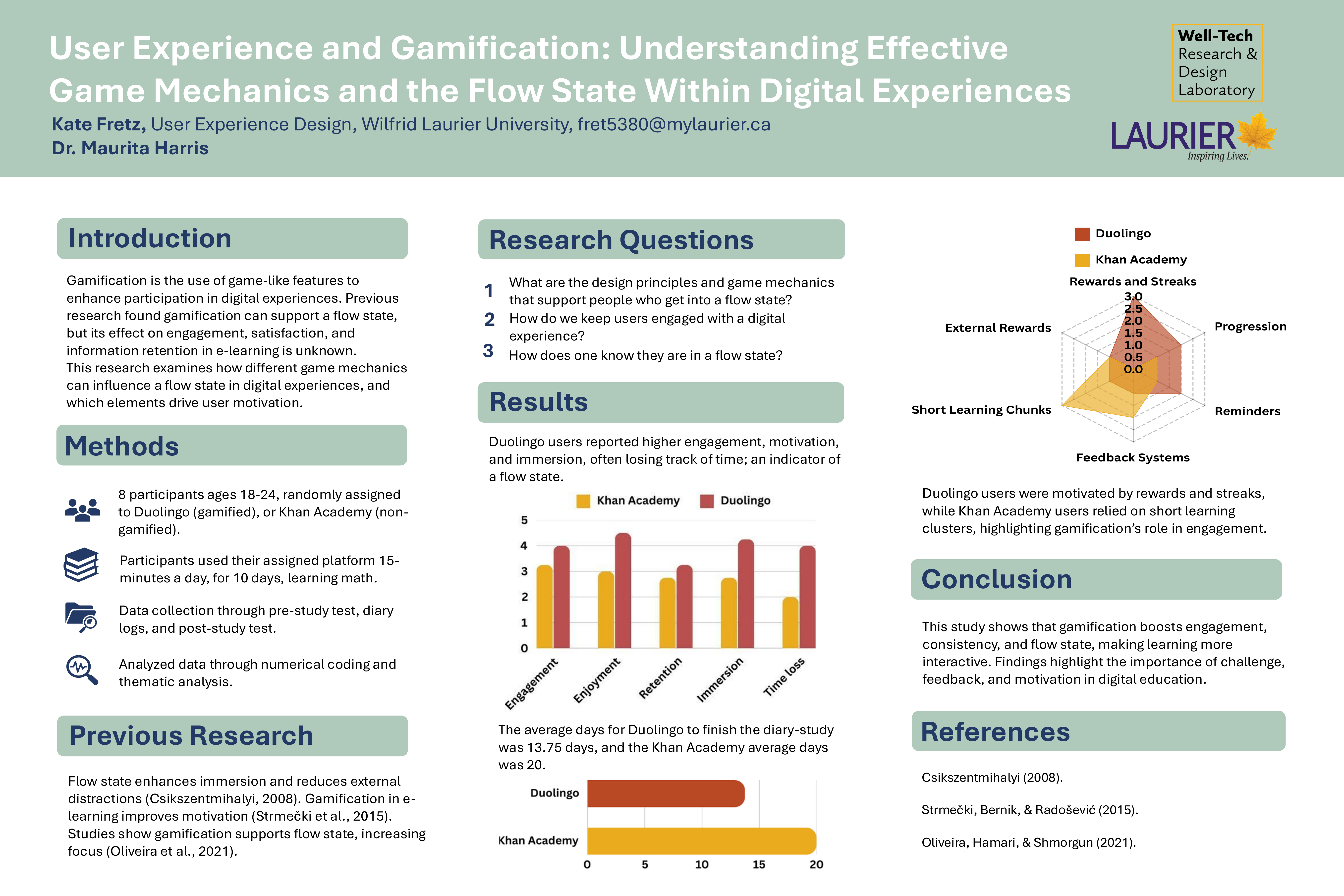
For my undergraduate honours thesis, I investigated how gamification influences user engagement and flow state within digital learning environments.
While gamification has become a popular strategy across education, fitness, productivity, and digital products, there is still limited research examining which specific game mechanics help users stay motivated, engaged, and immersed over time.
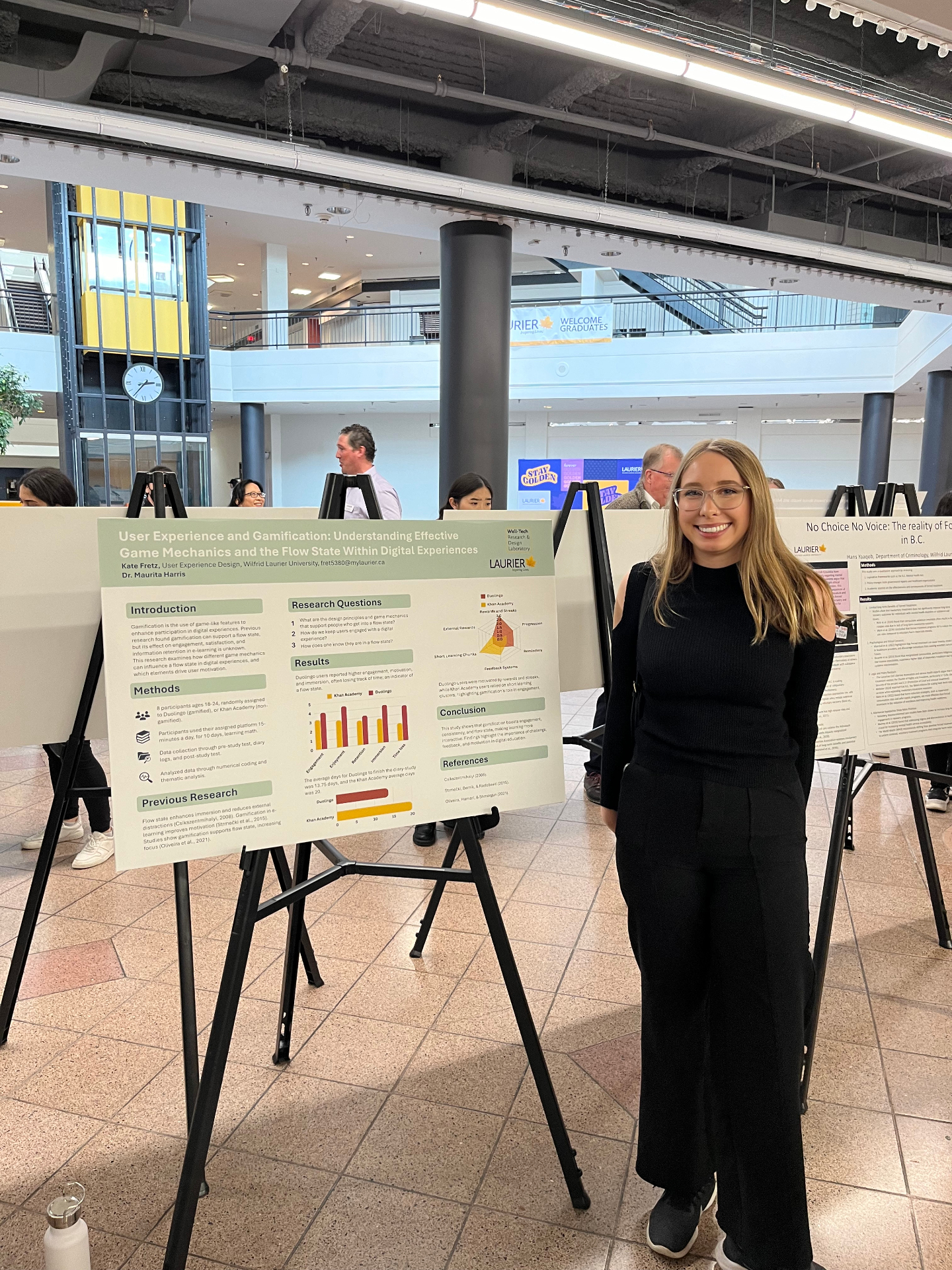
To explore this, I conducted a comparative mixed-methods diary study between two e-learning platforms: Duolingo, a gamified platform, and Khan Academy, a non-gamified platform. The project resulted in a full honours thesis and a research poster presented at the Academic, Creative and Engaged Research Showcase (ACERS).
Research Challenge
User Problem
Learners often disengage from e-learning platforms when the experience lacks feedback, motivation, and a sense of progress.
Design Problem
Product teams often use gamification as a surface-level feature without understanding which mechanics actually support engagement and flow.
Research Opportunity
Compare a gamified and non-gamified learning platform to understand which design mechanics drive motivation, consistency, and immersive learning.
Research Questions
What game mechanics and design principles support people in achieving a flow state?
How can digital experiences keep users engaged over time?
How can we identify when a user has entered a flow state within a digital experience?
Background & Literature Review
Before designing the study, I conducted a literature review on flow theory, self-determination theory, gamification, digital learning, and motivation in user experience design.
The research was grounded in Csikszentmihalyi’s concept of flow state, which describes a mental state where users become deeply immersed in an activity and may lose track of time. I also explored Self-Determination Theory, which explains how autonomy, competence, and relatedness can support intrinsic motivation.
The literature review revealed a key research gap: while gamification and flow state are often discussed separately, fewer studies examine how specific game mechanics contribute to flow in real-world digital learning platforms.
Flow State
Deep immersion, focus, time loss, and a sense of control.
Gamification
The use of game-like features such as points, streaks, rewards, feedback, and progress tracking.
Self-Determination Theory
Motivation supported by autonomy, competence, and relatedness.
Methodology
A 10-day mixed-methods diary study comparing Duolingo and Khan Academy.
Study details
- 8 participants
- Ages 18–24
- Randomly assigned to Duolingo or Khan Academy
- 15 minutes of math learning per day
- 10-day study period
- Remote participation
- Pre-study surveys, daily diary logs & post-study survey
Duolingo
GamifiedA gamified learning platform using rewards, streaks, progress tracking, reminders, and interactive challenges.
Khan Academy
Non-gamifiedA more traditional e-learning platform using instructional videos, short quizzes, structured lessons, and feedback systems.
Data collection & analysis
Pre-study survey
Captured participant background and baseline experience before the study began.
Daily diary logs
Tracked engagement and consistency over the full 10-day period.
Post-study survey
Measured satisfaction, motivation, perceived retention, immersion, time loss and flow indicators.
Analysis
Likert responses coded numerically; open-ended responses analysed through thematic analysis.
What I Did
As the independent researcher, I owned the full process from concept to final presentation.
Key Findings
4.0 vs 3.25
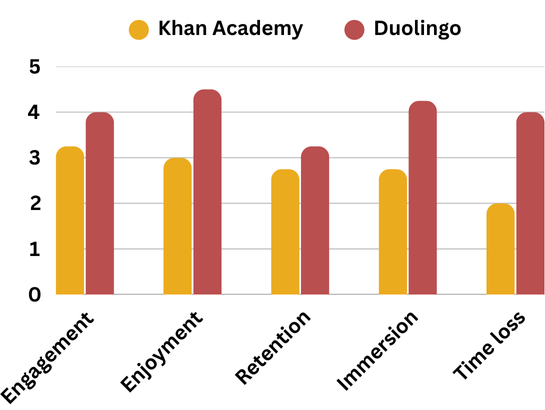
avg. engagement score
Gamification Increased Engagement
Duolingo participants reported higher engagement than Khan Academy participants. This suggests that gamified mechanics may help sustain focus and interaction over time.
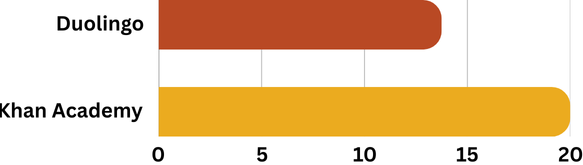
13.75 vs 20
days to complete
Gamified Learners Completed the Study Faster
Duolingo participants finished the diary study in an average of 13.75 days, compared to 20 days for Khan Academy. This suggests gamification supported consistency and momentum.
Rewards + Streaks
top motivators
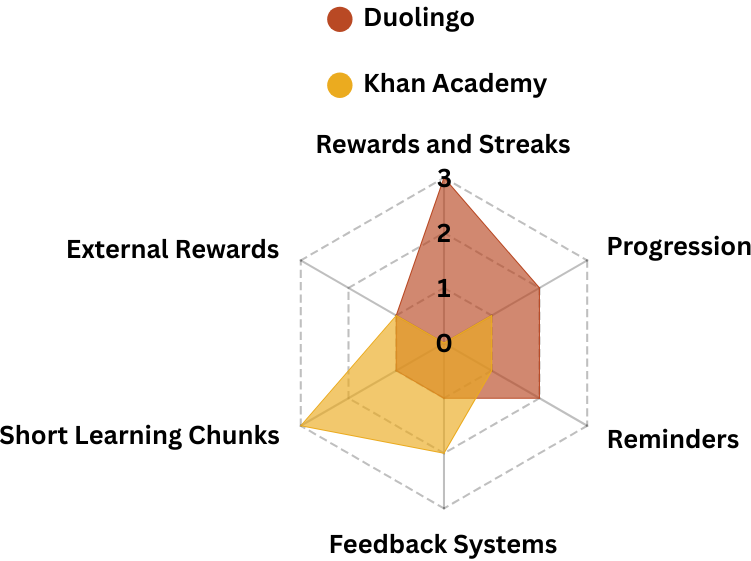
Rewards and Streaks Were Strong Motivators
Duolingo users were most motivated by rewards, streaks, progress tracking, and reminders. Khan Academy users relied more on short learning chunks and feedback systems.
↑ Immersion
flow indicators
Gamification Supported Flow State Indicators
Duolingo participants reported stronger signs of flow, including higher immersion, time loss, effortless task completion, and feeling in control of the learning experience.
Emotional
connection, not just function
Motivation Was Emotional, Not Just Functional
Gamified features helped create a stronger emotional connection to the learning experience, making users more likely to enjoy and continue the task.
Research Artifacts & Data
Poster, charts and visual findings from the study.
Design Implications
The findings suggest that gamification should not be treated as a decorative layer added at the end of a product. When designed intentionally, game mechanics can support motivation, consistency, and emotional engagement.
For UX and product designers, the strongest opportunities include:
These principles can apply beyond e-learning to onboarding flows, productivity tools, wellness apps, fitness platforms, loyalty programs, and AI-powered digital experiences.
Limitations
Although the study revealed meaningful patterns, several limitations shaped the findings.
Reflection
This project was my first experience leading an independent research study from concept to final presentation. It strengthened my skills in research design, participant recruitment, survey creation, quantitative analysis, thematic coding, academic writing, and research communication.
One of the biggest lessons I learned was the importance of combining numbers with participant stories. The quantitative data showed differences in engagement, but the qualitative responses explained why those differences existed.
If I were to continue this research, I would expand the participant pool, increase the study duration, include objective retention testing, and explore how AI-powered personalization could support motivation and flow in digital learning experiences.
Skills Demonstrated
This project helped shape my interest in designing digital experiences that are not only usable, but motivating, immersive, and emotionally engaging.